

Disclosure: FitProGuides may earn a commission when you buy through qualifying links. This does not change the price you pay or our editorial recommendations.
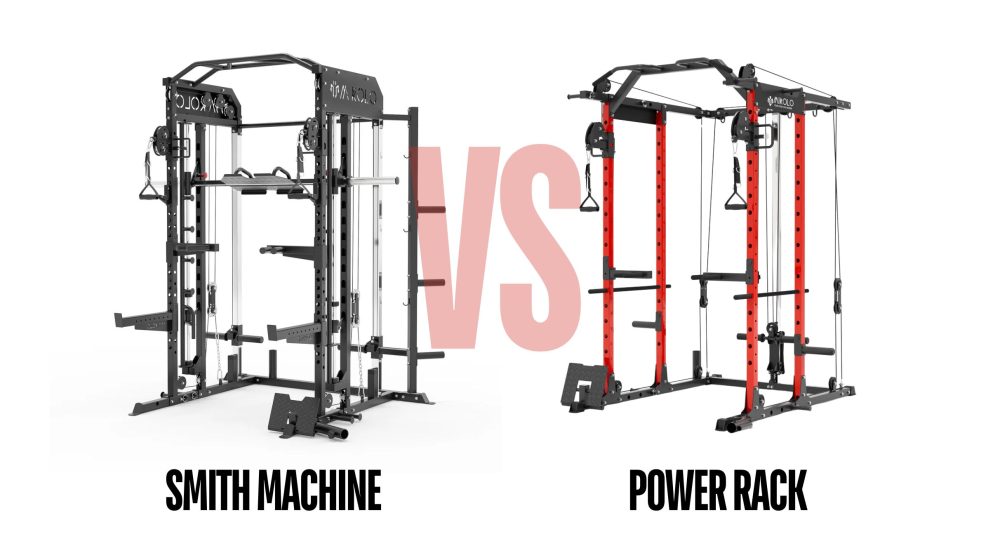
Choose a power rack if your priority is free-barbell skill, strength transfer, and a simple system you can expand over time. Choose a Smith machine if you value a guided bar, fast re-racking, and controlled hypertrophy work. For most home gyms, neither option is automatically better for muscle growth. The right choice depends on how you train, whether you lift alone, the safeties you will actually use, and the true space and cost of the complete setup.
Modern all-in-one units can combine a Smith bar, free-weight rack, and functional trainer in one frame. If your budget and footprint allow it, that hybrid format removes much of the either-or decision.
Smith Machine vs Power Rack: Quick Decision
| Decision factor | Smith machine | Power rack |
|---|---|---|
| Bar path | Guided on rails | Free in three dimensions |
| Best for | Controlled reps, hypertrophy, solo accessory work | Barbell skill, strength, sport-specific free-weight practice |
| Safety system | Bar hooks plus adjustable stops | J-cups plus straps, pins, or spotter arms |
| Learning demand | Lower balance demand | More technique and bar control |
| Typical entry cost | Usually higher for a dedicated or all-in-one unit | Often lower for a basic rack, but add bar, plates, and bench |
| Space | Frame can be deep; all-in-one models need cable and attachment clearance | Rack may be compact, but a 7-foot bar needs loading clearance on both sides |
| Upgrade path | Often brand- and model-specific | Broad attachment ecosystem when upright size and hole spacing are standard |
| Muscle growth | Effective when sets are progressed and trained hard | Effective when sets are progressed and trained hard |
The Biggest Difference Is the Bar Path
A Smith machine attaches the bar to vertical or slightly angled guide rails. You control the load up and down, but the machine controls the horizontal path. Most models let you rotate the bar into hooks at several heights. Adjustable stops should still be set before heavy squats or presses; the hooks are not a substitute for a correctly positioned fail-safe.
A power rack holds a separate barbell on J-cups. Once unracked, the bar can move in every direction. That freedom lets you practice the same squat, bench press, and overhead-press skills used with a free bar elsewhere, but it also requires more coordination.
The fixed path is not automatically good or bad. It is useful when you want repeatable positioning and less balance demand. It can feel awkward if the rail path does not suit your stance, bench position, or body proportions. A free bar allows self-selected movement, but only if the lifter has the technique and room to control it.
Which Builds More Muscle?
For hypertrophy, the practical answer is a tie. A systematic review and meta-analysis comparing machine and free-weight training found no meaningful difference in muscle growth when training programs were comparable. Strength gains were more specific: people improved most on the type of movement they practiced. You can review the open-access research summary.
That means:
- A Smith machine can build substantial muscle when you use appropriate exercises, train through a useful range of motion, and progressively add reps or load.
- A power rack is the better practice environment if your goal includes improving a free-bar squat, bench press, or overhead press.
- Exercise selection, weekly volume, effort, recovery, and consistency matter more for hypertrophy than the logo on the frame.
For beginners, the best equipment is the system they can set up correctly and use consistently. Our beginner Smith machine exercise guide covers guided-bar movements, while the Smith machine safety guide explains setup basics.
Which Is Safer for Training Alone?
Both can support solo training when their safeties are set correctly. Neither is safe merely because it has steel around the bar.
Smith machine safety
- Set the mechanical stops just below the lowest controlled point of the rep.
- Confirm you can rotate and rack the bar from your working position.
- Test the empty or lightly loaded bar before adding working weight.
- Do not rely on wrist rotation alone when training close to failure.
Power rack safety
- Use full-length safety straps or pins for squats and bench presses inside the rack.
- Set the safeties high enough to catch a failed rep but low enough not to interrupt good form.
- Center the bench and verify bar clearance before loading.
- Use spotter arms only within their rated configuration and mounting instructions.
A Smith machine may feel simpler because the bar cannot drift forward or backward. A correctly configured power rack provides a reliable mechanical catch while preserving free-bar movement. Your routine, not the category name, determines the real safety margin.
Space: Measure the Complete Training Zone
Do not compare frame dimensions alone. Mark the complete operating area on the floor before buying.
For a power rack, include:
- Rack depth and any rear plate storage.
- The full barbell width.
- Room on both sides to load plates.
- Bench movement in and out of the rack.
- Overhead and pull-up clearance.
For a Smith or all-in-one machine, include:
- Frame depth plus cable trolley access.
- Room for the Smith bar sleeves and plates.
- Space behind the unit for plate storage or selectorized stacks.
- Clearance for spotter arms, dip handles, leg-press plates, and cable attachments.
- Enough front space for a bench, rows, and low-pulley movements.
A basic rack can have a smaller frame, while a 7-foot bar can make its working width surprisingly large. An all-in-one Smith station can replace several machines but may be deeper and heavier. Compare actual room-fit numbers in our best Smith machines guide.
Budget: Compare the Whole System
A power rack often has the lower starting price, but the usable package also needs a barbell, plates, a bench, collars, and sometimes a pull-up or cable attachment. A Smith machine typically costs more upfront because the guided-bar mechanism is built in. An all-in-one unit may also include cables, storage, a pull-up bar, and free-weight J-cups.
Use a complete-system budget:
- Frame or machine.
- Freight and room-of-choice delivery if needed.
- Barbell, plates, and collars.
- Bench and floor protection.
- Attachments required in the first year.
- Installation help if the unit is too heavy or complex for your household.
If price is the main constraint, start with our budget Smith machine guide. Do not buy an attachment ecosystem until you confirm upright size, hole diameter, hole spacing, and the manufacturer’s compatibility rules.
Exercise Fit
A Smith machine is especially useful for:
- Split squats and reverse lunges with reduced balance demand.
- Hip thrusts with quick re-racking.
- Calf raises and controlled squat variations.
- Incline or flat presses when the bench can be aligned with the rail path.
- Rows and presses performed close to muscular failure with properly set stops.
A power rack is especially useful for:
- Free-bar squats and bench presses.
- Overhead presses when ceiling height permits.
- Rack pulls and pin presses.
- Pull-ups and rack-compatible accessories.
- Programs where barbell technique and free-weight strength are primary goals.
Deadlifts are usually performed from the floor in front of either system, so the rack itself is not required. Olympic lifts need adequate open space, flooring, and appropriate plates; they should not be treated as a default inside-rack exercise.
Attachments and Cable Training
Traditional power racks often provide the broadest modular ecosystem, especially when they use common upright dimensions and hole patterns. Smith machines used to be less expandable, but current home-gym products frequently combine a Smith bar, free-weight rack, cable crossover, pull-up station, and storage.
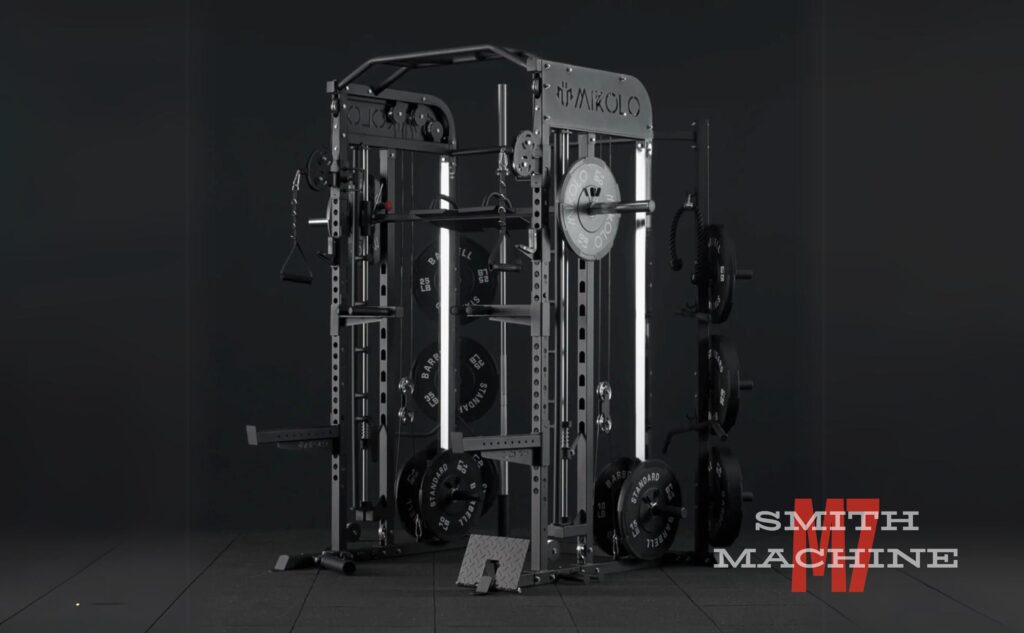
Browse current Smith machine configurations only after checking room dimensions and included attachments. Our guide to Smith machine accessories explains what to prioritize.
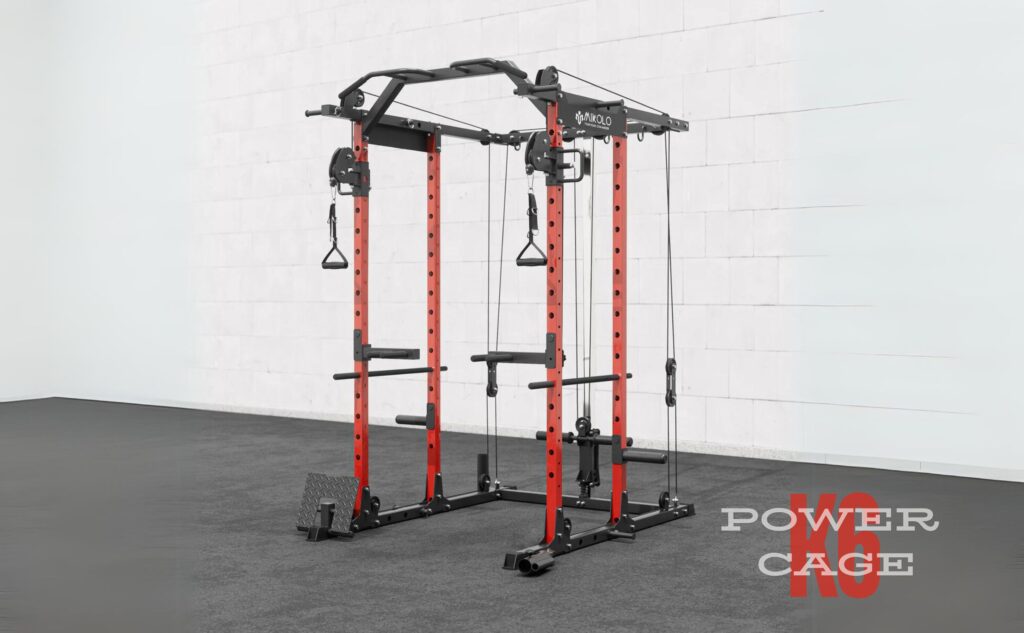
For a current example of an expandable rack format, see our Mikolo K6 power rack review. If cables matter, also understand how the 1:1 vs 2:1 pulley ratio changes handle resistance.
Who Should Choose Each Option?
Choose a Smith machine if:
- You prioritize controlled hypertrophy work over free-bar skill.
- You often train alone and value fast bar re-racking.
- You want a Smith-plus-cable or hybrid all-in-one station.
- You prefer less balance demand for split squats, presses, calf raises, and hip thrusts.
- You have confirmed that the rail path and machine dimensions suit your body and room.
Choose a power rack if:
- Your main goals are free-bar squats, bench presses, and overhead presses.
- You want strength that transfers directly to barbell testing or competition.
- You prefer a simpler frame with a long-term attachment path.
- You are comfortable learning bar control and setting rack safeties.
- You already own or plan to buy a quality barbell, plates, and bench.
Choose a hybrid if:
- Two people with different training preferences share the gym.
- You want free weights, guided lifting, and cables without separate stations.
- You can accommodate the larger footprint, assembly demands, and higher initial cost.
Frequently Asked Questions
Is a Smith machine better than a power rack for beginners?
It can be easier to start because the bar path is guided, but beginners can learn safely in either system. The important factors are instruction, manageable loads, and correctly set stops or rack safeties.
Can a Smith machine replace a power rack?
It can replace many exercises, but it cannot reproduce free-bar skill because the rails control the bar path. A hybrid unit with front J-cups and spotter arms can support both types of training.
Do power racks build more muscle?
Not inherently. Research comparing machine and free-weight training does not show a meaningful hypertrophy advantage for one category when programs are comparable. Free weights are more specific for improving free-weight strength.
Which is better for a small home gym?
Measure the working area, not just the frame. A compact rack may be smaller, but a full bar requires side clearance. An all-in-one Smith machine may be deeper yet replace separate cable and storage stations.
Bottom Line
A power rack is the stronger default for free-barbell skill, training specificity, and modular expansion. A Smith machine is the stronger default for guided hypertrophy work, quick re-racking, and all-in-one functionality. Both can build muscle and both require correctly positioned safety hardware.
Choose by writing down your five most-used exercises, marking the full training zone on the floor, and pricing the complete system. That process will usually make the right answer obvious before you buy.