

Affiliate disclosure: FitProGuides may earn a commission if you buy through links on this page, at no extra cost to you. We only link to equipment pages when they are relevant to the exercise or setup advice.
The best Smith machine exercises for beginners are the ones that let you learn a stable bar path, control the lowering phase, and use the safety catches before the weight gets challenging. Start with squat, bench press, incline press, Romanian deadlift, split squat, hip thrust, row, and calf raise variations before moving into heavier free-weight work.
If you are still choosing equipment for a home gym, compare this starter plan with our guides to the best Smith machines for home gyms, Smith machine vs power rack tradeoffs, and 1:1 vs 2:1 pulley ratios. Those pages help you decide whether a guided bar, a rack, or a cable-heavy all-in-one machine fits your space.
Beginner setup checklist before your first set
- Set the safety stops first. For squats and presses, test the bottom position with an empty bar so the stops catch the bar before it can pin you.
- Start lighter than you think. Many Smith bars are counterbalanced, so the bar may not feel like a standard 45 lb Olympic bar.
- Use slow reps. Lower for about two seconds, pause briefly, then lift with control. Beginners get more from repeatable reps than from grinding heavy sets.
- Keep joints stacked. Knees track over toes on lower-body moves; wrists stay stacked over elbows on presses.
- Stop one to three reps before failure. A Smith machine can help solo lifters, but it is not a substitute for smart loading.
For more safety context, use this article alongside our guide on how to use a Smith machine safely and effectively.
8 best Smith machine exercises for beginners
1. Smith machine squat
Best for: learning squat depth and leg drive without balancing a free bar.
- Set the bar around upper-chest height and place the safeties slightly below your bottom squat position.
- Stand with your feet slightly forward of the bar, about shoulder width.
- Brace your core, sit between your hips, and keep knees tracking over your toes.
- Drive through mid-foot and heel to stand tall without bouncing out of the bottom.
Beginner dose: 2–3 sets of 8–10 reps.
2. Smith machine bench press
Best for: building pressing confidence when training without a spotter.
- Place a flat bench so the bar lowers to mid-chest, not your neck.
- Set the safeties just above chest level when your shoulder blades are pinned back.
- Grip slightly wider than shoulder width and keep wrists stacked.
- Lower under control, lightly touch or hover near the chest, then press up.
Beginner dose: 2–3 sets of 8–12 reps. If your shoulders feel awkward, use a slight incline or switch to push-ups until pressing feels natural.
3. Smith machine incline press
Best for: upper chest and shoulder-friendly pressing practice.
- Set an adjustable bench around 20–35 degrees.
- Line the bar over your upper chest.
- Keep elbows slightly tucked instead of flared straight out.
- Press until arms are straight without shrugging your shoulders toward your ears.
Beginner dose: 2 sets of 8–10 reps after flat pressing, or use it as your main press if it feels better.
4. Smith machine Romanian deadlift
Best for: hamstrings, glutes, and learning a hip hinge.
- Start with the bar around mid-thigh height.
- Keep a soft bend in your knees and push your hips back.
- Lower the bar until you feel a hamstring stretch while your back stays neutral.
- Squeeze glutes to stand tall; do not lean back at the top.
Beginner dose: 2–3 sets of 8–10 reps. This movement should feel like a controlled stretch, not a lower-back lift.
5. Smith machine split squat
Best for: legs, glutes, balance, and correcting side-to-side strength gaps.
- Place one foot forward and one foot back like a stationary lunge.
- Lower straight down until the front thigh is roughly parallel or your comfortable range ends.
- Keep most pressure through the front foot.
- Stand up without pushing off the back leg too much.
Beginner dose: 2 sets of 6–8 reps per side. Use bodyweight first if the setup feels unstable.
6. Smith machine hip thrust
Best for: glutes with a repeatable bar path.
- Set a bench behind you and position your upper back on the edge.
- Place the bar across the hip crease with a pad if available.
- Start with feet flat and knees bent around 90 degrees at the top.
- Drive hips up, pause, then lower with control.
Beginner dose: 2–3 sets of 10–12 reps.
7. Smith machine inverted row
Best for: upper back strength and posture without needing cable attachments.
- Set the bar around waist height and lock it in place.
- Lie underneath, grip the bar, and keep your body straight.
- Pull your chest toward the bar while squeezing shoulder blades together.
- Lower until arms are straight again.
Beginner dose: 2 sets of 6–10 reps. Bend your knees to make it easier; straighten legs to make it harder.
8. Smith machine standing calf raise
Best for: calves and ankle control with a simple setup.
- Set the bar across your upper traps as you would for a squat.
- Stand tall and rise onto the balls of your feet.
- Pause at the top, then lower until you feel a stretch.
- Use slow reps instead of bouncing.
Beginner dose: 2–3 sets of 10–15 reps.
Simple 2-day Smith machine beginner workout
Run this plan two non-consecutive days per week for your first four weeks. Add reps first, then add weight only when all sets feel controlled.
| Day A | Sets x reps | Focus |
|---|---|---|
| Smith squat | 3 x 8 | Leg drive and depth |
| Smith bench press | 3 x 8 | Chest and triceps |
| Smith Romanian deadlift | 2 x 10 | Hamstrings and glutes |
| Smith inverted row | 2 x 8 | Upper back |
| Day B | Sets x reps | Focus |
|---|---|---|
| Smith split squat | 2 x 8 each side | Single-leg control |
| Smith incline press | 3 x 8 | Upper chest and shoulders |
| Smith hip thrust | 3 x 10 | Glutes |
| Smith calf raise | 2 x 12 | Calves |
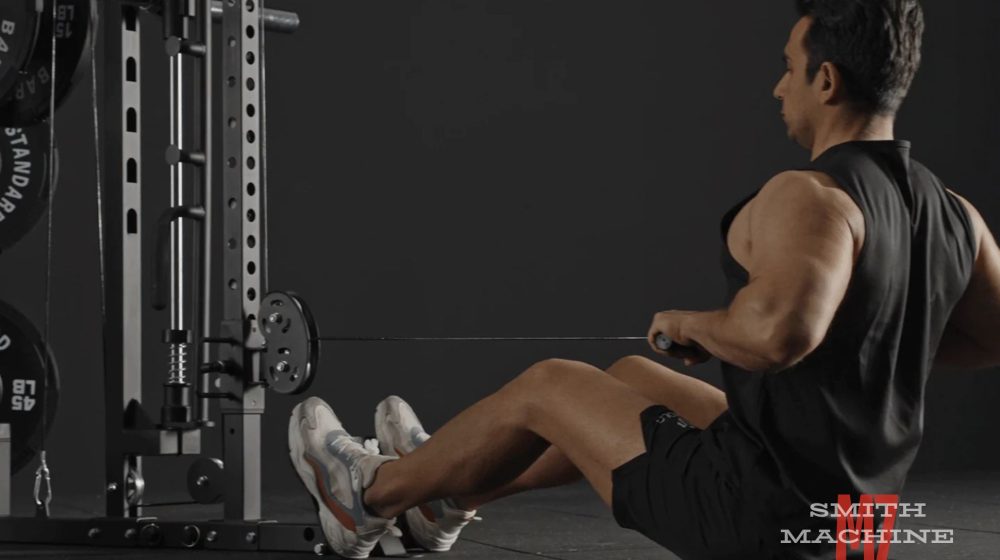
If your machine includes cable attachments, add one easy cable row or lat pulldown after the main work. Check our Smith machine attachments guide before buying add-ons, because compatibility varies by frame, hole spacing, cable system, and storage layout.
Common beginner mistakes to avoid
- Standing too far forward on squats. A slight forward foot position is normal, but extreme stance changes can make the movement feel awkward.
- Using the Smith machine as a license to max out. Safety hooks help, but they do not remove risk if the safeties are set wrong.
- Ignoring the machine angle. Some Smith machines are angled. Face the direction that lets the bar travel naturally for the exercise.
- Copying free-weight form exactly. The fixed rail changes the bar path. Use the variation that feels joint-friendly and repeatable.
- Skipping maintenance. Sticky rails and loose hardware make training less predictable. See our Smith machine assembly and maintenance checklist if your home unit needs a tune-up.
Should beginners use a Smith machine or free weights?
Use both if you can. The Smith machine is useful for learning repeatable movement patterns, training alone, and practicing exercises when balance is the limiting factor. Free weights still build coordination and stabilizer control in ways a fixed bar cannot. For most beginners, the practical answer is to use the Smith machine for controlled practice, then gradually add dumbbells, cable work, and free-weight patterns as confidence improves.
If you are building a compact home gym, read our budget Smith machine guide before buying. Space, ceiling height, safety stops, cable ratio, and attachment storage matter more than chasing the heaviest advertised capacity.
FAQ
How often should a beginner use the Smith machine?
Two full-body sessions per week is enough for most beginners. Add a third day only after your joints feel good, your technique is consistent, and recovery is easy.
Is the Smith machine safe for squats?
It can be safe when the safeties are set correctly, the load is appropriate, and your stance fits the machine’s bar path. Do not assume it is automatically safe just because the bar is guided.
Can you build muscle with Smith machine exercises?
Yes. Muscle growth depends on consistent training, enough effort, progressive overload, nutrition, and recovery. The Smith machine can provide a stable way to train hard, especially for beginners and solo lifters.
What weight should beginners start with?
Start with the empty Smith bar or a very light load. Add weight only when you can complete every rep with the same range of motion and no joint discomfort.
What is the best Smith machine exercise for beginners?
The Smith machine squat is usually the best first lower-body exercise, while the Smith bench press is the easiest first upper-body press. Pair those with Romanian deadlifts and rows for a balanced starter plan.